
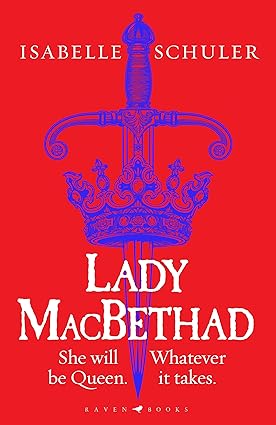
There were a couple of reasons why I was drawn to reading this book. Firstly, I love novels like Anita Diamant’s The Red Tent and Madeline Miller’s Circe which reimagine classic works of world literature from a female perspective. Also, I am an Ulster Scot and attached to my Celtic heritage. Schuler’s novel disappoints on both these fronts.
When it comes to a fresh perspective, there is much in Shakespeare’s Lady Macbeth to reimagine. She is a sinister, controlling character but she is also intelligent, socially skilled and she has a conscience (‘Yet who would have thought the old man to have had so much blood in him?’ Macbeth, Act V, sc.1, lines 30-34). Schuler’s Gruoch (the future Lady MacBethad) has absolutely no redeeming or engaging qualities. She is superlatively entitled, believing in her right to be queen after her grandmother has a drug induced trip and informs her she will be ‘immortalised’. She believes in her own superiority and it causes her to be exceptionally cruel and lacking in empathy, for example when she sneers at Suthan for crying over the death of her infants. At the age of around 7 she tells MacBethad that she will murder anyone who stands between her and the crown and he believes her. She is odious to her saintly adoptive mother, Donalda, selfishly berating her on the day that she is widowed and later crowing about her own successes as the Lady of Moray, a role which should have been Donalda’s and came about because of the murder of Donalda’s husband and the disinheritance of her son.
Added to that, Gruoch is what we Celts would call thick as champ. She is no strategist, unlike her Shakespearian counterpart. She cannot see through Duncan’s motives when he sends her away from Scone, for example, and she often betrays her hand out of her need to seem superior. She adds pettiness to stupidity when she returns to Scone to make Duncan regret having forsaken her.
Gruoch, now Lady MacBethad, claims that in marrying MacBethad she has found her equal. This is risible; MacBethad is superior in terms of character (he shows some care for others), wits (he is able to plan the removal of Gillecomghain in way that plays to his advantage, although Gruoch’s brother Adair, a severely underdeveloped though interesting figure, messes up the plot) and general attitude (he is much, much less entitled although the grandson of the incumbent rather than the deposed King).
What is disturbing is that Schuler does not seem to realise she has created a monster and focuses all her efforts on her nauseating protagonist so that there are no other fully drawn characters in the novel.
Now, to my most irritating issue with the novel: historical inaccuracy. There is an epilogue in which Schuler encourages the reader to research the history of the story. She seems to have taken her own historical research as far as a cursory glance at Wikipedia. She repeatedly calls Christianity ‘the new religion’ although her story is set in the early 11th century and Christianity had been around in Scotland for nearly 5 centuries at that point. That’s like you or I calling a Gutenberg press ‘newfangled’. She has Picts speaking Gallic (Scots Gaelic). She does reference mormaers and torcs, although I am not so sure that torcs were still a status symbol in the 11th century but I would need to research that. She lauds Gruoch’s grandmother and her fellow pagans as ‘daughters of Druids’ although the druidic classes began to fade in Scotland from the fifth century. All this anachronism would be fine but Schuler claims to have done some research and also she calls her novel a ‘reclamation’ of Shakespeare’s anti-heroine whilst doing exactly what Shakespeare does: imposing the agenda of her own era and her personal inclinations onto the historical MacBeths. The difference is that Shakespeare does it much better.
The one nice little anachronistic touch was the use of the Weird Sister’s opening speech in Gaelic.
The use of the English language is a bit unsophisticated; the prose reads like a teenager’s journal but that’s part of the charm in some places.
All in all, this is not anywhere intellectual enough to be a response to Shakespeare, the protagonist is the worst fictional character I have ever encountered, the novel shows precious little research or planning and the prose reads like fan fiction of some kind. Nonetheless it’s a page turner. Go in with low expectations and you may enjoy it.
 Online English Literature Courses